Ebook America's War for the Greater Middle East: A Military History, by Andrew J. Bacevich
Reading, once again, will certainly give you something new. Something that you have no idea after that revealed to be populared with guide America's War For The Greater Middle East: A Military History, By Andrew J. Bacevich message. Some understanding or session that re obtained from checking out e-books is uncountable. More books America's War For The Greater Middle East: A Military History, By Andrew J. Bacevich you read, more understanding you obtain, and much more opportunities to always love reading books. Due to the fact that of this factor, reading publication must be begun from earlier. It is as just what you could get from the book America's War For The Greater Middle East: A Military History, By Andrew J. Bacevich
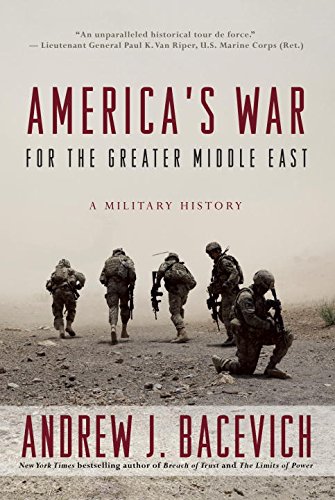
America's War for the Greater Middle East: A Military History, by Andrew J. Bacevich

Ebook America's War for the Greater Middle East: A Military History, by Andrew J. Bacevich
Some people may be laughing when taking a look at you reviewing America's War For The Greater Middle East: A Military History, By Andrew J. Bacevich in your extra time. Some could be appreciated of you. As well as some could want resemble you which have reading pastime. Just what concerning your personal feeling? Have you felt right? Reviewing America's War For The Greater Middle East: A Military History, By Andrew J. Bacevich is a requirement and a hobby simultaneously. This problem is the on that will make you really feel that you need to read. If you recognize are seeking the book qualified America's War For The Greater Middle East: A Military History, By Andrew J. Bacevich as the selection of reading, you could discover here.
To overcome the trouble, we now supply you the innovation to purchase guide America's War For The Greater Middle East: A Military History, By Andrew J. Bacevich not in a thick published documents. Yeah, checking out America's War For The Greater Middle East: A Military History, By Andrew J. Bacevich by online or getting the soft-file simply to review could be among the means to do. You might not feel that reviewing a book America's War For The Greater Middle East: A Military History, By Andrew J. Bacevich will certainly work for you. But, in some terms, May individuals successful are those which have reading practice, included this sort of this America's War For The Greater Middle East: A Military History, By Andrew J. Bacevich
By soft data of guide America's War For The Greater Middle East: A Military History, By Andrew J. Bacevich to check out, you might not need to bring the thick prints everywhere you go. Whenever you have going to check out America's War For The Greater Middle East: A Military History, By Andrew J. Bacevich, you could open your gizmo to read this publication America's War For The Greater Middle East: A Military History, By Andrew J. Bacevich in soft documents system. So easy as well as rapid! Reviewing the soft file book America's War For The Greater Middle East: A Military History, By Andrew J. Bacevich will certainly give you simple means to check out. It could additionally be quicker since you can read your e-book America's War For The Greater Middle East: A Military History, By Andrew J. Bacevich anywhere you want. This online America's War For The Greater Middle East: A Military History, By Andrew J. Bacevich could be a referred publication that you can enjoy the remedy of life.
Since e-book America's War For The Greater Middle East: A Military History, By Andrew J. Bacevich has fantastic benefits to check out, lots of people now grow to have reading behavior. Supported by the established innovation, nowadays, it is simple to get the book America's War For The Greater Middle East: A Military History, By Andrew J. Bacevich Even the e-book is not existed yet in the marketplace, you to hunt for in this internet site. As what you could find of this America's War For The Greater Middle East: A Military History, By Andrew J. Bacevich It will actually ease you to be the initial one reading this publication America's War For The Greater Middle East: A Military History, By Andrew J. Bacevich and obtain the benefits.
LONGLISTED FOR THE NATIONAL BOOK AWARD • A searing reassessment of U.S. military policy in the Middle East over the past four decades from retired army colonel and New York Times bestselling author Andrew J. Bacevich
From the end of World War II until 1980, virtually no American soldiers were killed in action while serving in the Greater Middle East. Since 1990, virtually no American soldiers have been killed in action anywhere else. What caused this shift? Andrew J. Bacevich, one of the country’s most respected voices on foreign affairs, offers an incisive critical history of this ongoing military enterprise—now more than thirty years old and with no end in sight.
During the 1980s, Bacevich argues, a great transition occurred. As the Cold War wound down, the United States initiated a new conflict—a War for the Greater Middle East—that continues to the present day. The long twilight struggle with the Soviet Union had involved only occasional and sporadic fighting. But as this new war unfolded, hostilities became persistent. From the Balkans and East Africa to the Persian Gulf and Central Asia, U.S. forces embarked upon a seemingly endless series of campaigns across the Islamic world. Few achieved anything remotely like conclusive success. Instead, actions undertaken with expectations of promoting peace and stability produced just the opposite. As a consequence, phrases like “permanent war” and “open-ended war” have become part of everyday discourse.
Connecting the dots in a way no other historian has done before, Bacevich weaves a compelling narrative out of episodes as varied as the Beirut bombing of 1983, the Mogadishu firefight of 1993, the invasion of Iraq in 2003, and the rise of ISIS in the present decade. Understanding what America’s costly military exertions have wrought requires seeing these seemingly discrete events as parts of a single war. It also requires identifying the errors of judgment made by political leaders in both parties and by senior military officers who share responsibility for what has become a monumental march to folly. This Bacevich unflinchingly does.
A twenty-year army veteran who served in Vietnam, Andrew J. Bacevich brings the full weight of his expertise to this vitally important subject. America’s War for the Greater Middle East is a bracing after-action report from the front lines of history. It will fundamentally change the way we view America’s engagement in the world’s most volatile region.
Praise for America’s War for the Greater Middle East
“Bacevich is thought-provoking, profane and fearless. . . . [His] call for Americans to rethink their nation’s militarized approach to the Middle East is incisive, urgent and essential.”—The New York Times Book Review
“Bacevich’s magnum opus . . . a deft and rhythmic polemic aimed at America’s failures in the Middle East from the end of Jimmy Carter’s presidency to the present.”—Robert D. Kaplan, The Wall Street Journal
“A critical review of American policy and military involvement . . . Those familiar with Bacevich’s work will recognize the clarity of expression, the devastating directness and the coruscating wit that characterize the writing of one of the most articulate and incisive living critics of American foreign policy.”—The Washington Post
“[A] monumental new work.”—The Huffington Post
“An unparalleled historical tour de force certain to affect the formation of future U.S. foreign policy.”—Lieutenant General Paul K. Van Riper, U.S. Marine Corps (Ret.)
- Sales Rank: #49596 in Books
- Brand: imusti
- Published on: 2016-04-05
- Released on: 2016-04-05
- Format: Deckle Edge
- Original language: English
- Number of items: 1
- Dimensions: 9.55" h x 1.48" w x 6.64" l, 1.75 pounds
- Binding: Hardcover
- 480 pages
Features
Review
“[Andrew J.] Bacevich is thought-provoking, profane and fearless. . . . [His] call for Americans to rethink their nation’s militarized approach to the Middle East is incisive, urgent and essential.”—The New York Times Book Review
“Bacevich’s magnum opus . . . a deft and rhythmic polemic aimed at America’s failures in the Middle East from the end of Jimmy Carter’s presidency to the present.”—Robert D. Kaplan, The Wall Street Journal
“A critical review of American policy and military involvement . . . Those familiar with Bacevich’s work will recognize the clarity of expression, the devastating directness and the coruscating wit that characterize the writing of one of the most articulate and incisive living critics of American foreign policy.”—The Washington Post
“[A] monumental new work . . . One of the grim and eerie wonders of his book is the way in which just about every wrongheaded thing Washington did in that region in the fourteen-plus years since 9/11 had its surprising precursor in the two decades of American war there before the World Trade Center towers came down.”—The Huffington Post
“The book reveals a number of critical truths, exposing deep flaws that have persisted for decades in American strategic thinking—flaws that have led successive American presidents to ask the American military to accomplish the impossible, often while barely providing it with the resources to accomplish even the most modest of goals. . . . Read Bacevich—not for the solutions he proposes but to be sobered by the challenge.”—National Review
“In one arresting book after another, Andrew J. Bacevich has relentlessly laid bare the failings of American foreign policy since the Cold War. This one is his sad crowning achievement: the story of our long and growing military entanglement in the region of the most tragic, bitter, and intractable of conflicts.”—Richard K. Betts, director, Saltzman Institute of War and Peace Studies, Columbia University
“Andrew Bacevich offers the reader an unparalleled historical tour de force in a book that is certain to affect the formation of future U.S. foreign policy and any consequent decisions to employ military force. He presents sobering evidence that for nearly four decades the nation’s leaders have demonstrated ineptitude at nearly every turn as they shaped and attempted to implement Middle East policy. Every citizen aspiring to high office needs not only to read but to study and learn from this important book. This is one of the most serious and essential books I have read in more than half a century of public service.”—Lieutenant General Paul K. Van Riper, U.S. Marine Corps (Ret.)
“Bacevich asks and answers a provocative, inconvenient question: In a multigenerational war in the Middle East, ‘Why has the world’s mightiest military achieved so little?’ ”—Graham Allison, director, Belfer Center for Science and International Affairs, and Douglas Dillon Professor of Government at Harvard’s John F. Kennedy School of Government
“Andrew Bacevich lays out in excruciating detail the disasters orchestrated over decades by the architects of the American empire in the Middle East. Blunder after blunder, fed by hubris along with cultural, historical, linguistic, and religious illiteracy, has shattered cohesion within the Middle East. The wars we have waged have given birth to a frightening nihilistic violence embodied in radical jihadism. They have engendered an inchoate rage among the dispossessed and left in their wake a series of failed and disintegrating states. These wars have, as Bacevich writes, laid bare the folly of attempting to use military force as a form of political, economic, and social control. Bacevich is one of our finest chroniclers of the decline of empire, and America’s War for the Greater Middle East is an essential addition to his remarkable body of work.”—Chris Hedges, former Middle East bureau chief for The New York Times and author of Wages of Rebellion: The Moral Imperative of Revolt
“Andrew Bacevich’s thoughtful, persuasive critique of America’s crusade for the Greater Middle East should be compulsory reading for anyone charged with making policy for the region. We cannot afford to repeat the past misjudgments on the area. As Bacevich wisely argues, the stakes are nothing less than the future well-being of the United States.”—Robert Dallek, author of Camelot’s Court: Inside the Kennedy White House
About the Author
Andrew J. Bacevich is a retired professor of history and international relations at Boston University. A graduate of the U.S. Military Academy, he served for twenty-three years as a commissioned officer in the United States Army. He received his PhD in American diplomatic history from Princeton. Before joining the faculty of Boston University in 1998, he taught at West Point and at Johns Hopkins University. His three most recent books—Breach of Trust, Washington Rules, and The Limits of Power—all hit the New York Times bestseller list. A winner of the Lannan Notable Book Award, he lectures frequently at universities around the country. He lives with his wife, Nancy, in Walpole, Massachusetts.
Excerpt. © Reprinted by permission. All rights reserved.
1
War of Choice
From the outset, America’s War for the Greater Middle East was a war to preserve the American way of life, rooted in a specific understanding of freedom and requiring an abundance of cheap energy. In that sense, just as the American Revolution was about independence and the Civil War was about slavery, oil has always defined the raison d’être of the War for the Greater Middle East. Over time, other considerations intruded and complicated the war’s conduct, but oil as a prerequisite of freedom was from day one an abiding consideration.
As a young man I required no instruction in that relationship, whose sweetness I had tasted at first hand. In June 1969, a newly commissioned shavetail fresh out of West Point, I was home on leave courting the girl who was to become my wife. She lived on Chicago’s South Side. My mother lived in northwest Indiana.
Every evening I drove my brand--new Mustang Mach I—-candy--apple red with black piping—-into Chicago to see my beloved and then in the early morning hours returned home. Before each trip, I stopped at a service station to top off. Ten gallons at 29.9 cents per gallon usually sufficed. The three bucks weren’t trivial—-a second lieutenant’s pay came to $343 per month before taxes (more importantly, before the monthly car payment)—-but the expense took a backseat to romance. I do not recall wondering where the gas came from—-Texas? California?—-nor about how much more there was. Like most Americans, I took it for granted that the supply was inexhaustible. All I knew for sure was that with four years of West Point behind me and Vietnam just ahead, life behind the wheel of a pony car in the summer of 1969 was pretty good.
It is easy to disparage this version of freedom, as postwar social critics from C. Wright Mills and David Riesman to William Whyte and Vance Packard had already done and others would do. For the ostensibly alienated and apathetic citizens of postwar America, trapped in a soul--deadening “new universe of management and manipulation,” as Mills put it, freedom had become little more than “synthetic excitement.”1
Maybe so. Yet whatever the merit of that critique, it never made much of a dent in the average American’s aspirations. The American way of life may have been shallow and materialistic, its foundation a bland conformity. But even for people of modest means, the exercise of American--style freedom did not lack for pleasures and satisfactions.
As with the smell of a new car, those pleasures tended to be transitory. But an unspoken premise underlying that way of life was that there was more still to come, Americans preferring to measure freedom quantitatively. More implied bigger and better. Yet few of those driving (or coveting) the latest made--in--Detroit gas--guzzler appreciated just how precarious such expectations might be.
As I sped off to Chicago each evening, with radio and AC blasting, the gasoline in my tank was increasingly likely to come from somewhere other than a stateside oilfield. In 1969, imports already accounted for 20 percent of the 15 million barrels that Americans consumed daily. The very next year U.S. domestic oil production peaked at nearly 12 million barrels per day, thereafter beginning a decline that continued through the remainder of the century and appeared irreversible. The proportion of oil coming from abroad increased accordingly. Within a decade, imports of foreign oil had reached 8 million barrels per day.2
By 1973, even I was obliged to take notice. That fall, in retaliation for the U.S. supporting Israel in the October War, Arabs suspended oil exports to the United States and the West. The impact of the embargo was immediate and severe. The resulting oil shortage all but paralyzed the U.S. economy and produced widespread alarm among Americans suddenly deprived of the mobility that they now considered their birthright. Oil had become a weapon, wielded by foreigners intent on harming Americans. Here, it seemed, coming out of nowhere, was a direct existential threat to the United States.
With the crisis inducing another eyeball--to--eyeball confrontation between the United States and the Soviet Union, Secretary of State Henry Kissinger announced that U.S. forces were on alert, pending their possible deployment to the Middle East. At the time, I was a captain, stationed at Fort Bliss, Texas, alongside El Paso and just across from Mexico. The regiment in which I served had war plans to deploy to West Germany to participate in NATO’s defense of Western Europe. If required, we probably could have occupied Juarez. But we had no plans to fight in the Persian Gulf, whether to thwart a threatened Soviet intervention there or to seize Arab oil fields.3 The very notion seemed preposterous. At the time it was. Not for long, however.
Fortunately, no such deployment occurred, the immediate emergency passed, and oil imports from the Persian Gulf eventually resumed. Yet the availability and price of gasoline had now become and thereafter remained a matter of national concern. Even as Americans were learning to live with nuclear weapons—-the prospect of a nuclear exchange with the Soviet Union now appearing more theoretical than real—-they were also learning that they could not live without oil. Ever so subtly, the hierarchy of national security priorities was beginning to shift.
As an immediate response to the crisis, the Nixon administration hastily cobbled together a plan that promised, in the president’s words, “to insure that by the end of this decade, Americans will not have to rely on any source of energy beyond our own.” Project Independence, Nixon called it. The immediate emphasis was on conservation. Details of what the government intended beyond urging Americans to save were vague, Nixon simply vowing that “we will once again have plentiful supplies of energy,” with the energy crisis “resolved not only for our time but for all time.”4
This did not occur, of course, but Nixon’s vision persisted. The nation’s political agenda now incorporated the goal of energy independence as one of those “must--do” items that somehow never get done, like simplifying the tax code or reducing cost overruns on Pentagon weapons programs.
The idea persisted because it had broad popular appeal. Yet in some quarters, the larger policy implications of pursuing energy independence did not sit well. The very effort implied retrenchment or giving in. This was not the way the world was supposed to work in the latter half of the twentieth century. Rather than the United States accom-modating others—-in this case, the newly empowered Organization of the Petroleum Exporting Countries (OPEC), with its largely Arab membership—-others were expected to accommodate the United States.
As an outgrowth of this dissatisfaction, the notion that American military muscle might provide a suitable corrective began to insinuate itself into the policy debate. Writing in the January 1975 issue of Commentary, for example, the noted political scientist Robert W. Tucker bemoaned Washington’s apparent unwillingness even to consider the possibility of armed intervention in the Arab world. “If the present situation goes on unaltered,” Tucker warned, “a disaster resembling the 1930s” beckoned. To “insist that before using force one must exhaust all other remedies, when the exhaustion of all other remedies is little more than the functional equivalent of accepting chaos” was therefore the height of folly. When it came to something as important as oil, the putative lessons of the recently concluded Vietnam War simply didn’t apply. Tucker wanted policymakers to get serious about the possibility of using force in the Middle East.5
Two months later, in Harper’s, the pseudonymous but apparently well--connected Miles Ignotus went a step further, outlining in detail a plan to seize Saudi oil fields outright. Four divisions plus an air force contingent, with Israel generously pitching in to help, would do the trick, he argued. Echoing Tucker, Ignotus categorized spineless American leaders alongside “the craven men of Munich.” Allowing OPEC to dictate the price of oil amounted to “a futile policy of appeasement” and would inevitably lead to further disasters.6 In contrast, forceful military action promised an easy and nearly risk--free solution.
Ignotus was actually Edward Luttwak, well--known national security gadfly and Pentagon consultant. In positing a U.S. attack on Saudi oil fields, he was pursuing an agenda that looked far beyond mere energy security. Luttwak was part of group seeking to “revolutionize warfare.” Saudi Arabia, he and his like-minded colleagues believed, offered the prospect of demonstrating the feasibility of using “fast, light forces to penetrate the enemy’s vital centers,” thereby providing a shortcut to victory. This was an early version of what twenty years later became known as the Revolution in Military Affairs. The invasion of Iraq in 2003, Luttwak would later claim, signified “the accomplishment of that revolution.”7
Along with a strikingly strident tone, a strong sense of entitlement pervaded both essays. That Americans might submit to “the political blackmail of the kings and dictators of Araby,” Ignotus wrote, in order to ensure access to “a product [Arabs] had neither made nor found” represented an affront. Sure, the vast petroleum reserves were located on “their” territory. But for Tucker and Ignotus, that fact qualified as incidental at best. Middle East oil properly belonged to those who had discovered, developed, and actually needed it. By all rights, therefore, it was “ours,” a perspective that resonated with many ordinary Americans. All that was required to affirm those rights was the vigorous use of U.S. military power.
Notably absent from this analysis, however, was any appreciation for context. Tucker and Ignotus alike showed no interest in the recent history of the Middle East. They ignored the dubious legacy of previous Western interventionism, especially by Great Britain, until recently the region’s imperial overlord. That the United States was willy--nilly supplanting the British as the dominant power in the Arab world and more broadly in the Greater Middle East ought to have given Americans pause. After all, the lessons to be taken from the British experience were almost entirely cautionary ones. That was not a baton that the Americans were grasping but a can of worms.
More astonishingly still, neither Tucker nor Ignotus showed any interest in religion or its political implications. Theirs was a thoroughly secular perspective. Islam, therefore, simply went unmentioned. Once having asserted direct control over Arab oil, Tucker and Ignotus took it for granted that U.S. troops would remain for years to come. Yet they were oblivious to the possibility that a protracted military occupation might encounter unforeseen snags, whether by violating local sensitivities or enmeshing the United States in ancient sectarian or ethnic disputes. In contemplating action, the United States routinely took into account the potential response of powerful adversaries like the Soviet Union. More often than not, it factored in the concerns of valued allies like West Germany or Japan. That a lesser country like Iran or Iraq or Saudi Arabia could obstruct or stymie a superpower was not a proposition that many Americans at this juncture were prepared to entertain. The policy prescriptions offered by Tucker and Ignotus reflected this view—-even if the North Vietnamese had only recently exposed it as false.
This first round of proposals to militarize U.S. policy in the Middle East found little favor in the Pentagon. Ever since World War II, apart from the brief intervention in Lebanon that Dwight D. Eisenhower had ordered back in 1958—-a virtually bloodless comma inserted between Korea and Vietnam—-America’s military had by and large steered clear of the region, leaving it in the hands of diplomats and spooks.8
Now, in the early 1970s, U.S. forces had their hands full with other concerns. The just--concluded American war in Vietnam had left the armed services, especially the U.S. Army, battered in body and spirit. Recovering from that unhappy ordeal was the order of the day. This meant re--equipping and adjusting to the end of the draft, priorities addressed with the Soviet threat very much in mind. The prospect of intervening in the Persian Gulf figured as exceedingly improbable. The idea of sending U.S. forces elsewhere in the wider Islamic world, to Afghanistan, say, or Somalia, appeared absurd.
So when Secretary of Defense Elliott Richardson released his annual report to Congress in April 1973, he evinced little interest in the Middle East and only perfunctory concern about energy security. The 126--page document devoted exactly one anodyne paragraph to each.
In the first, Richardson expressed his hope for an end to “the potentially explosive Arab--Israeli conflict.” He cited U.S. arms sales and its “limited military presence” as intended “to produce stability” and to encourage negotiations. Yet Richardson also made it clear that the core problem wasn’t Washington’s to solve: “Peace and stability will be possible only if all the parties involved develop a mutual interest in accommodation and restraint.”
In the second paragraph, while noting that the Persian Gulf contained “approximately one--half of the world’s proven oil reserves,” Richardson emphasized that the United States would look “primarily to the states in the area to maintain peace and stability.”9 Pentagon priorities lay elsewhere.
A year later, in the wake of the October War and with Americans still reeling from the first oil shock, Richardson’s successor James R. Schlesinger made it clear that those priorities had not changed. The Pentagon remained fixated on the U.S.--Soviet competition. When the United States evaluated threats to national security, Schlesinger wrote, “We do so primarily with the Soviet Union in mind.”
His 237--page report reflected that priority. Apart from a brief reference to the lessons of the most recent Arab--Israeli conflict, which merely “confirmed prior judgments” about war, Schlesinger ignored the Middle East altogether. Under the heading of “planning contingencies,” the defense secretary identified Europe, Northeast Asia, and (surprisingly) Southeast Asia as places where U.S. forces could potentially fight. The oil--rich lands touched by the waters of the Persian Gulf didn’t make the cut.10
The passing of a year brought yet another defense secretary but no real change in perspective. In November 1975 Donald Rumsfeld ascended to the post of Pentagon chief, which he held for only fourteen months, his tenure curtailed when Gerald Ford lost the 1976 presidential election. In January 1977, Rumsfeld’s annual report, issued as eight years of Republican rule were coming to an end, claimed credit over the course of more than three hundred pages for vastly improving U.S. military capabilities while simultaneously issuing dire warnings about the ever--increasing Soviet threat. In its competition with the Soviet Union, the United States was getting stronger and stronger while falling further and further behind.
For Rumsfeld too, therefore, the Middle East remained an afterthought. The United States had a “fundamental interest in uninterrupted access to Middle East oil and gas,” he acknowledged. But satisfying that interest was not going to entail the commitment of U.S. forces and was not going to absorb any substantial part of the Pentagon’s budget. The troops and the dollars were needed elsewhere. So Rumsfeld affirmed Washington’s preference for outsourcing the problem to “reliable friendly forces (for example Iran, Saudi Arabia, Morocco) capable of contributing to regional order.” Arming “friendly, important governments” that were themselves “striving to maintain peace and stability in the region” promised to suffice.11
Through the mid--1970s, in other words, Pentagon strategic priorities remained unaffected by developments in and around the Persian Gulf. To hawkish observers like Robert Tucker, growing U.S. energy dependence along with the rise of OPEC might signify a “radical shift in power” and therefore require drastic action.12 Those actually responsible for formulating U.S. national security policy didn’t see it that way. They shied away from addressing the implications of any such shift. All that was now about to change as Jimmy Carter became president.
In a world of nation--states, good will and good intentions will not suffice to achieve peace. Simply avoiding war—-the minimalist definition of peace—-implies a meeting of devious minds. In statecraft, calculation necessarily precedes concurrence.
Jimmy Carter saw himself as a peacemaker. On that score, there is no doubting the sincerity of his aspirations. He meant well—-by no means the least among his many admirable qualities. Yet when it came to the exercise of power, Carter was insufficiently devious. He suffered from a want of that instinctive cunning that every successful statesman possesses in great abundance. Carter could be vain, petty, and thin--skinned—-none of these posed a fatal defect. But he lacked guile, a vulnerability that, once discovered, his adversaries at home and abroad did not hesitate to exploit.
One direct consequence was to trigger a full--scale reordering of U.S. strategic interests. From a national security perspective, as never before, the Greater Middle East began to matter. From the end of World War II to 1980, virtually no American soldiers were killed in action while serving in that region.13 Within a decade, a great shift occurred. Since 1990, virtually no American soldiers have been killed in action anywhere except in the Greater Middle East. President Carter neither intended nor foresaw that transformation—-any more than European statesmen in the summer of 1914 intended or foresaw the horrors they were unleashing. But he, like they, can hardly be absolved of responsibility for what was to follow.
When Carter moved into the Oval Office in late January 1977, he inherited a mess. The previous decade and a half, punctuated by assassinations, racial unrest, cultural upheaval, the forced resignation of a president, and a costly, divisive war, had left Americans in something of a funk. That the economy was in a shambles didn’t help matters. U.S. power and influence seemed to be waning. The amoral machinations of Richard Nixon and his chief lieutenant Henry Kissinger—-cutting deals with the Kremlin, toasting Red China’s murderous leaders, and abandoning the South Vietnamese to their fate—-mocked the ideals that America ostensibly represented.
Like every new president, Carter promised to turn things around. He would be the un--Nixon. On the stump, he had repeatedly assured Americans, “I’ll never lie to you.” At a time when Washington seemed especially thick with liars, cheats, and thieves, this constituted a radical commitment. Carter took it upon himself to repair the nation’s moral compass. This defined what history had summoned him to do. In foreign policy, that meant aligning actions with words. The United States would once more stand for freedom. It would promote peace. It would advance the cause of universal human rights.
Most helpful customer reviews
58 of 63 people found the following review helpful.
The definitive analysis of our Iliad in the middle east
By PM
This is the most incisive military analysis of America in the Middle East from Carter to Obama. An expose of the self seeking and self promoting actions of our generals and politicians and the fatuous neoconservative militarism which presently guides the foreign policy of our country. Brilliant! There is no better exposition of the delusion associated with the self proclamation of critically strategic areas of the world which before the end of the Cold War held absolutely no importance whatsoever to our well being. The folly of reliance on military power to cure political and cultural defiencies, defined as an absence of neoliberal Christian democracy, and the failure to attain that objective is documented in this engrossing study of self deception and evangelization.
When you finish reading this book you will understand the reasons why we cannot effectively engage middle eastern problems but also why we can't bring ourselves to disengage.
When american soldiers are sent overseas and become casualties their blood becomes a symbol to shed more blood. We have seen this in every war fought since 1945. The men we elect to the presidency with the exception of Eisenhower have had no clue how to conduct foreign policy when the lives of our men and women are at risk. We seem to be caught up in some macho vendetta with the entire world. The continuation of this vendetta has proven to be very profitable for a few wealthy people far from the firing line. It has proven to be amenable to vote getting. It has proven to be amenable to the self promotion of those officers above field level command into whose hands our servicemen have been encared.
It is clear that this country is in more danger today than 35 years ago when we decided to engage directly in the middle eastern quagmire. Yes, it was a quagmire before we got involved and transformed an oil protection mission into preventive war interventionism with the purpose of imposing neoliberal democracy upon Stone Age societies. Our strategy is a muddle, a chimera.
All Americans have to ask ourselves some very hard questions about just what we are doing in the Middle East and how do we expect it to end.
This mission cannot go on forever and Americans cannot expect to remain insulated from the blowback from the wars we are conducting.
109 of 120 people found the following review helpful.
Excellent Summary of How We Got Into This Mess -
By Loyd Eskildson
Author Bacevich opens by contending that our military involvement in the greater Middle East began with the failure to rescue the American hostages in our Tehran embassy. Mechanical breakdowns, very limited visibility due to stirred up dust, and a chopper accidently hitting a stationary C-130 resulted in the mission being canceled and the deaths of 8 Americans. While President Carter quickly took responsibility, Bacevich points out that the myriad errors in design and execution were attributable to the military professionals involved.
Bacevich also points out that Carter's predecessors going back to WWII had done him no favors with their forging ill-advised relationships and foolhardy commitments. Nonetheless, Carter had launched America's War for the Greater Middle East, compounding those inherited errors. That war continues today, with no end in sight.
America's War for the Greater Middle East was a war to preserve the American way of life, rooted in an abundance of cheap energy. In 1969, imports already accounted for 20% of American consumption, and the next year U.S. domestic oil production peaked. By 1973, in retaliation for U.S. support for Israel in the October War, Arabs suspended oil exports to the U.S. and the West. Eventually, oil imports resumed, but the availability and price of gasoline had now become a matter of national concern. The hierarchy of national security priorities was beginning to shift from nuclear weapons and the Soviet Union.
President Nixon launched a plan to insure that Americans would not have to rely on any source of energy beyond our own (Project Independence), but the idea that retrenchment was needed did not sit well with some. There was a strong sense of entitlement, notwithstanding Britain's prior experiences. However, the just-concluded war in Vietnam effectively dampened any enthusiasm for further military adventurism.
From the end of WWII to 1980, virtually no American soldiers were KIA in the Greater Middle East. Since 1990, virtually no American soldiers have been killed in action anywhere except in the Greater Middle East.
When Carter became president, he first had to confront what he called an 'inordinate fear of communism' that had found the U.S. in bed with corrupt, repressive regimes. However, he hadn't figured on the Iranian Revolution. Previously the CIA helped engineer a coup that returned the Shah to his throne while overthrowing a democratically elected Iranian government. Nixon sold top-line American weapons to Iran, now flush with cash thanks to booming oil exports - envisioning Iran as ensuring stability in the gulf, along with Saudi Arabia.
The Shah, however, was losing his grip on power - having previously alienated segments of society ranging from secularized liberals to religious conservatives. All saw the Shah as an American lackey, the U.S. as parasitic. Both the Shah and Washington dithered. On 1/16/79, he fled into exile.
The Iranian Revolution that overthrew the Shah triggered a second 'oil shock' as Iranian production fell off sharply, and OPEC announced a succession of price increases. Carter's ratings sank. Prior to addressing the nation, he concluded that America's oil addiction was the underlying problem and had led to losing our moral bearings. 'Too many of us now worshipped self-indulgence and consumption.' Carter saw one path - constant conflict between narrow interests ending in chaos and immobility, and another with us united in control of our destiny via conservation. It became a conflict between self-interest and self-sacrifice. Eventually, the speech became known as Carter's "crisis of confidence" (malaise) speech. With that refusal, the Persian Gulf and its environs acquired massively heightened significance.
Carter had just previously signed off on a memo committed the U.S. to assist Afghan insurgents warring against the Soviet-supported regime in Kabul. The amount was small - only $500,000, and material provided primarily medical supplies and communications equipment. Brezinski saw this as needed to dissuade the Soviets from meddling in the Persian Gulf. On 11/1/79, Brezinski met with Iran's prime minister, in an effort to forge a new positive relationship. However, on 11/4, Iranian students opposed to Carter's allowing the Shah to enter the U.S. for medical treatment, overran the U.S. embassy in Tehran. The Carter administration had no intention of another coup, feared by the students, and the Ayatollah had not ordered the seizure or even prior knowledge of it. Unfortunately, he soon endorsed what the students had one and transformed a difficult problem into a much bigger one. Carter then switched to a goal of maintaining a military preponderance in the region.
Adding the Persian Gulf to the list of U.S. strategic priorities added to defending Western Europe and Northeast Asia. The Soviet invasion of Afghanistan and Reagan's election combined to revive the Cold War. The task, however, was complicated by the fact that states receiving U.S. 'protection' such as Iran, did not want or cooperate with it. The U.S. began with upgrading ports and airfields to which it had been promised access in Egypt, Kenya, Morocco, Oman, and Somalia. Meanwhile, Saudi Arabia undertook building bases far beyond its needs or ability to operate. A series of training exercises was programmed to cycle U.S. forces through the region - aimed to acclimate U.S. troops to conditions in the region and promote an increasing tolerance for their presence. The U.S. also began poring billions in military aid into the area - $9.1 billion in 1984, $11 billion the next year. It was assumed that memory of prior upheavals dismantling the Ottoman Empire after WWI, creation of Israel in 1948, overthrowing Iran's government in 1953, the Suez Crisis of 1956, the Arab-Israeli Wars of 1967 and 1973 would fade away. It was also assumed that Kremlin leaders would play their assigned role as bogeymen - that changed with Gorbachev becoming leader (March, 1985) and working to call off the Cold War.
While Weinberger continued to warn of Soviet military threats, Gorbachev accepted U.S. terms in 1987 for a treaty eliminating intermediate-range nuclear missiles from Europe, and announced plans to end occupation of Afghanistan. In February 1989, the final contingent of Soviet forces left Afghanistan. By end of 1989, our army found itself with more tanks and tank crews than it knew what to do with - made redundant by the sudden end of the Cold War.
We then quickly fingered Saddam's Iraq as the new Public Enemy #1, and the peace dividend never materialized. To this point, U.S. containment efforts had been directed against states. Reality was that religion (Sunni vs. Shiite), and resentment over Western meddling, including border changes, which the U.S. had become heir to were to play a far stronger role than ever imagined. Iraq, Israel-Palestine, and Pakistan were prime examples of the latter.
U.S. assistance to the mujahedin during the 1980s totaled between $4 - $5 billion, matched by Saudi Arabia.
The Marine barracks bombing in Lebanon (had been placed there as a poorly thought through means of ending conflict in Lebanon) was not avenged, nor were additional Marine deaths by Syrian artillery fire at the Lebanon airport, or the two U.S. aircraft shot down by Syrian air defenses east of Beirut. Thomas Friedman wrote that the Marines had 'accomplished virtually nothing.' Hezbollah could reasonably claim to have inflicted a decisive defeat on the world's preeminent superpower - a conclusion not lost on other U.S. opponents.
By 1979, Libya's efforts towards liberating Palestine etc. had earned it a place on our list of state sponsors of terrorism. Reagan concluded Gaddafi needed to be taught a lesson. In 1973, Gaddafi had claimed ownership of the Gulf of Sidra. The U.S. had rejected Gaddafi's claim without pressing the issue. Reagan changed that by having the U.S. Navy progressively challenging Gaddafi, dispatching carriers Forrestal and Nimitz across the 'line of death.' Two responding Libyan fighters were shot down. A later attack in response to the West Berlin disco bombing and against Gaddafi personally at Benghazi (18 F-111s from Britain - 2 turned back due to equipment failures, four aborted while on target approach, a 7th missed its assigned target, and an 8th shot down; 15 A-6 Intruders from aircraft carriers destroyed the airfield) - overall achieving little, as Gaddafi was apparently warned in advance. That was the inauguration of an extended and futile experiment in employing military might to defeat terrorism - even though Reagan was pleased.
7 of 7 people found the following review helpful.
Reasons why the USA has been and still is failing in its Middle Eastern policies.
By Ronald E. Parsons
is a good tool with which to refresh memories prior to reading the author's conclusions.
However if a reader doesn't have the time or inclination to read the entire book but has access to a copy, he can read the last two chapters consisting of 28 pages, and in that "nutshell" obtain the essence of the book's content, plus the author's feelings about how things over there might pan out. I will say this: He isn't optimistic. (Again), if the reader has kept up with events as they occurred, he is likely to agree with the author's views. Essentially U.S. leadership since 1980 has not been up to the task of taking any action that might have been effective in that Middle Eastern morass . And though Mr. Bacevich doesn't say so, a reader can come away wondering whether or not he suggests that our form of government is incapable of successfully dealing with the set of circumstances that exist there. Our system causes elected officials to concentrate mainly on the next election whether it be two, four or six years hence. And command military officers usually don't have long before they can retire comfortably. Is that an incentive merely to hold things together until the next three-star comes along to take over? Added to this is the attitude of the majority of the U.S. population who want someone else to set things straight while we go about our separate lives.
Author Bacevich brings up the fact that we have a considerable element who have little or no incentive to end our wars. They are those who haul in substantial pay and profits as long as conflict continues.
See all 212 customer reviews...
America's War for the Greater Middle East: A Military History, by Andrew J. Bacevich PDF
America's War for the Greater Middle East: A Military History, by Andrew J. Bacevich EPub
America's War for the Greater Middle East: A Military History, by Andrew J. Bacevich Doc
America's War for the Greater Middle East: A Military History, by Andrew J. Bacevich iBooks
America's War for the Greater Middle East: A Military History, by Andrew J. Bacevich rtf
America's War for the Greater Middle East: A Military History, by Andrew J. Bacevich Mobipocket
America's War for the Greater Middle East: A Military History, by Andrew J. Bacevich Kindle
America's War for the Greater Middle East: A Military History, by Andrew J. Bacevich PDF
America's War for the Greater Middle East: A Military History, by Andrew J. Bacevich PDF
America's War for the Greater Middle East: A Military History, by Andrew J. Bacevich PDF
America's War for the Greater Middle East: A Military History, by Andrew J. Bacevich PDF