Fee Download Cornelius Van Til: An Analysis of His Thought, by John M. Frame
Cornelius Van Til: An Analysis Of His Thought, By John M. Frame. In what instance do you like checking out so a lot? Just what regarding the sort of guide Cornelius Van Til: An Analysis Of His Thought, By John M. Frame The have to check out? Well, everyone has their own reason why needs to read some books Cornelius Van Til: An Analysis Of His Thought, By John M. Frame Mainly, it will associate with their requirement to get knowledge from the publication Cornelius Van Til: An Analysis Of His Thought, By John M. Frame as well as desire to check out just to obtain home entertainment. Stories, tale book, and various other enjoyable publications end up being so popular today. Besides, the scientific books will certainly likewise be the very best reason to choose, particularly for the students, teachers, medical professionals, business person, and other careers which are fond of reading.
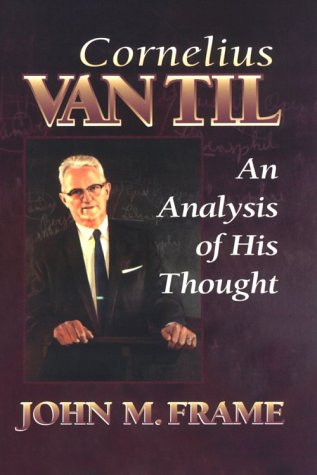
Cornelius Van Til: An Analysis of His Thought, by John M. Frame

Fee Download Cornelius Van Til: An Analysis of His Thought, by John M. Frame
Cornelius Van Til: An Analysis Of His Thought, By John M. Frame. Adjustment your routine to hang or waste the moment to only talk with your pals. It is done by your everyday, do not you feel tired? Now, we will certainly show you the extra practice that, in fact it's a very old habit to do that could make your life more certified. When really feeling tired of consistently talking with your good friends all downtime, you can find the book qualify Cornelius Van Til: An Analysis Of His Thought, By John M. Frame then review it.
If you obtain the published book Cornelius Van Til: An Analysis Of His Thought, By John M. Frame in on the internet book store, you may additionally find the exact same problem. So, you have to relocate establishment to store Cornelius Van Til: An Analysis Of His Thought, By John M. Frame and also hunt for the available there. However, it will not occur below. The book Cornelius Van Til: An Analysis Of His Thought, By John M. Frame that we will supply here is the soft documents principle. This is just what make you can easily locate and also get this Cornelius Van Til: An Analysis Of His Thought, By John M. Frame by reading this website. We offer you Cornelius Van Til: An Analysis Of His Thought, By John M. Frame the best product, constantly as well as always.
Never ever question with our deal, due to the fact that we will certainly always offer what you need. As like this upgraded book Cornelius Van Til: An Analysis Of His Thought, By John M. Frame, you could not discover in the various other place. But right here, it's extremely easy. Just click and also download and install, you could own the Cornelius Van Til: An Analysis Of His Thought, By John M. Frame When convenience will relieve your life, why should take the complex one? You can purchase the soft documents of guide Cornelius Van Til: An Analysis Of His Thought, By John M. Frame here and be participant people. Besides this book Cornelius Van Til: An Analysis Of His Thought, By John M. Frame, you can also discover hundreds lists of the books from lots of resources, collections, publishers, as well as writers in all over the world.
By clicking the web link that we offer, you can take guide Cornelius Van Til: An Analysis Of His Thought, By John M. Frame completely. Hook up to internet, download, and also save to your tool. Just what else to ask? Reading can be so very easy when you have the soft file of this Cornelius Van Til: An Analysis Of His Thought, By John M. Frame in your gizmo. You can additionally duplicate the file Cornelius Van Til: An Analysis Of His Thought, By John M. Frame to your workplace computer system or in the house and even in your laptop. Just discuss this excellent news to others. Suggest them to visit this page and also get their hunted for publications Cornelius Van Til: An Analysis Of His Thought, By John M. Frame.
The insights of Cornelius Van Til have generated intense discussion among friends and foes alike. Until now nearly everything written about Van Til has come from either uncritical followers or unsympathetic critics.
This volume, marking the one hundredth anniversary of Van Til’s birth, combines deep appreciation with incisive critical analysis of the renowned Westminster apologist’s ideas. John M. Frame offers warm personal reflections on Van Til’s life and a close examination of his thought, including his interaction with prominent figures in the Reformed, evangelical, and secular communities. In terms of its spirit, scope, clarity, and profundity, this volume is must reading for serious students of apologetics and theology.
- Sales Rank: #2152943 in Books
- Published on: 1995-09
- Original language: English
- Number of items: 1
- Dimensions: 1.66" h x 6.41" w x 9.43" l,
- Binding: Hardcover
- 463 pages
Review
"Superb. . . . Frame solves a number of enigmas which have puzzled students for
decades. He also shows the way for future work and sets an agenda for apologetics
which really needs to be heeded." --William Edgar, professor of apologetics, Westminster Theological Seminary, Philadelphia
"Frame has given us a particularly searching and comprehensive analysis of Cornelius Van Til’s theology and apologetics. He is especially qualified to do so." --Roger Nicole, visiting professor of theology, Reformed Theological Seminary, Orlando campus
"Brings much-needed clarity to nearly all aspects of Van Til’s thought. . . . Readers interested in apologetics in general will benefit immensely from this work. Students of theology also would do well to make this priority reading." --Stephen R. Spencer, Bibliotheca Sacra
About the Author
John M. Frame (A.B., Princeton University; B.D., Westminster Theological Seminary; M.A. and M.Phil., Yale University; D.D., Belhaven College) is the J. D. Trimble Professor of Systematic Theology and Philosophy at Reformed Theological Seminary in Orlando and the author of many books, including the four-volume Theology of Lordship series.
Most helpful customer reviews
14 of 15 people found the following review helpful.
An Analysis of Van Til the *theologian.*
By Jacob
Goal and thesis of the book: To provide a much-needed critical analysis of the legacy of Cornelius Van Til (8).
The Metaphysics of Knowledge: God as Self-Contained Fullness
This is Frame's favorite aspect of Van Til's thought, and probably the best section in the book. This is another way of saying God's aseity. God is sufficient in himself. From God's self-containment, we may say that God's unity implies his simplicity: "If there is only one God, then there is nothing "in" him that is independent of him" (55). How does God's revelation play into this? Due to the richness of God's nature, we could never know him left to ourselves. However, if God, a self-contained God--and a self-contained God who meets the standards of immanency and transcendence, reveals himself, then we have certain, sure knowledge of who this God is (transcendence) and how his revelation applies to concrete situations (immanence).
Absolute Personality
Non-Christian systems die on the altar of personality. Either they posit personal, but finite gods (Greek pantheon) or impersonal, infinite gods (Eastern religions). Only Christian theism posits a personal, absolute God. They do so because of the Trinity. To quote CVT, "the members of the trinity are exhaustively representational of one another" (qtd. Frame, 59). To end this section with a quote and call to action from Frame, "Impersonal facts and laws cannot be ultimate, precisely because they are not personal. They cannot account for rationality, for moral value, for the causal order of the universe, or for the universal applicability of logic" (60).
The Trinity
Ah, this is where the heresy charges come in! And given the renewed interest in Trinitarianism, this section can be very useful. Van Til begins by stating and affirming what the Church has taught on the Trinity. His position can be summarized in the following moves: Trinitarianism denies correlativism, the belief that God and creation are dependent on one another. God is three persons and one Person. Watch closely. He calls the whole Godhead "one person." He is not saying that God is one in essence and three in essence. The main question is "the one being personal or impersonal?" (67). Van Til is calling the whole Godhood one "person" in order to avoid making the essence of God to be merely an abstraction. Frame argues, "If the three persons (individually and collectively) exhaust the divine essence (are "coterminous" with it), then the divine essence itself must be personal" (68). And if God is an absolute person (he is), and he is one (he is), then there must be a sense in which he is a person. Granting the Augustinian circumincessio, every act of God is a personal act involving all three persons acting in unity (68).
The Problem of the One and the Many
I think Rushdoony was more excited about this than Van Til (see Van Til's response to Rush in Jerusalem and Athens). How do we find unity in the midst of plurality? Unbelief cannot answer this question. It always tends toward one or the other extreme. If abstract being is ultimate, then there are no particulars. If abstract particular is ultimate, then there is no truth. The Trinity is both personal one and many.
Soverignty of God and Analogous Reasoning
Van Til takes the standard, Dordtian view of election and reprobation. He twists it into his own language: equal ultimacy. He defends God against being the author of evil by saying God is the ultimate cause, not the proximate cause. Frame suggests that this doesn't get God off the hook and Van Til would have been better to stick with the Jobian theodicy.
There has been much confusion on Van Til's use of analogy. Aquinas used analogy between God and man in Neo-Platonic terms, suggesting a continuum of being between God and man. Van Til does not espouse Neo-Platonism. He should be interpreted that the language between God and man is different, but we should think God's thoughts after him.
The Clark Controversy
I am not going to review this part. Suffice to say he makes Clark look good.
Revelation
Contrary to popular opinion, Van Til does hold to general revelation. Given his view of God's sovereignty, all things reveal God's decree. (Man is receptively reconstructive of God's revelation. It is his job to re-interpret previously God-interpreted facts.) In short, Van Til holds to the typical Kuyperian view of revelation. From this Van Til posits a three-fold division in God's revelation: a revelation from God, from nature, and from self (120). This is perspectival, btw. As to Scripture, it is self-attesting and bears God's full authority. As such, it must be inerrant.
Presuppositions
A presupposition is not a belief that one must have before (temporally speaking) one comes to believe in other things; rather, it is a belief that is independent of some other knowledge and governs that knowledge to some extent.
CVT also distinguishes between proximate and ultimate presuppositions. Frame didn't develop this section as thoroughly as he could have. One of my few faults with the book.
Evidence
CVT does not disparage the use of evidence, many critics to the contrary. Rather, he denies the use of "brute facts." Given the Trinity, all facts and laws are correlative. Brute facts are "uninterpreted facts" and therefore meaningless, the constituents of a universe of pure chance. This means we cannot separate facts from meaning. We cannot challenge the unbeliever on a particular fact if we do not challenge his philosophy of fact. Again, see RJ Rushdoony on facts and evidence (JBA).
Part 3: The Ethics of Knowledge
Antithesis
Frame argues that Van Til was right in stressing the antithesis but his language rendered his own view of it ambiguous. To state it clearly: The natural man in principle is opposed to the truth of God. Psychologically, however, he does not live that way (cf. Greg Bahnsen, Van Til's Apologetic: Readings & Analysis, "The Psychology of Epistemology").
Common Grace
CVT holds to a "well-meant offer of salvation to a generality of men, including elect and non-elect."
I did enjoy Frame's interaction with Gary North's critique of Van Til on this point, mainly for Frame's humor. North's position: God gives ethical rebels enough rope to hang themselves for all eternity. "North accuses CVT of an implicit contradiction: as an amillennialist, he believes that the wicked will be victorious over the course in history, but how can they be victorious if the gifts of common grace are gradually withdrawn" (229). If I {JBA} can restate it another way: when the covenant-breaker becomes epistemologically self-conscious, he will not progress in knowledge and culture.
Frame notes that much of North's analysis is helpful but critiques him on the ambiguities of the word "favors."
Conclusion: overall quite good section of the book. Would have done better to show the tension between adhering to a Van Tillian epistemology but seeking a neutral, natural law ethic.
The Argument for Christianity
Spiral Argument
CVT points out that a true, biblically-faithful argument will be circular in nature. The starting point, the method, and the conclusion are involved in one another. CVT will point out that if the object under discussion were just another fact, then the charge and objection of circularity would have more warrant. But the object under discussion is not merely another fact, but the God of the universe! If I {JBA} may state it another way: when you are seeking to establish your highest authority, you will reason and prove it by your highest authority. If you validate your highest authority (A) by something other than your highest authority (B), then A is no longer your highest authority, but now B is.
Reasoning by Presupposition
Frame now analyzes the Transcendental Argument for the Existence of God (TAG). CVT claimed that unless you presuppose the God of the Bible, you cannot know anything. Frame modifies this bold claim by pointing out that what CVT actually gave us in his formulation is a conclusion and a practical strategy.
Other Thinkers
Frame then analyzes CVT on Scholasticism, Kant, Barth, and Dooyeweerd. He then proceeds to evaluate the current Van Tillian school of thought. The most consistent (and vocal) followers of CVT are the theonomists. If CVT destroyed neutrality (which he did) then the question, now applied to civil law, is if not pluralism, then what law? They answer God's law. There are other Van Tillian thinkers: Edgar, Poythress, Knudsen, and even Schaeffer.
Evaluation*
This book is a joy to read over and over again. It differs with Greg Bahnsen's magnum opus in that it deals with Van Til the theologian whereas Bahnsen dealt with Van Til the apologist. The two books complement one another. Another less known, but equally potent Van Til summar is R.J. Rushdoony's By What Standard: An Analysis of the Philosophy of Cornelius Van Til.
25 of 25 people found the following review helpful.
Best Intro to Van Til
By Steve Jackson
Generally, the best way to study a philosopher is to read an important work of his. For example, we study Plato by studying "The Republic" or some of his shorter dialogues. With others - such as Hegel - it's best to read various excerpts from his works, trying to get a sense of what he is up to. With a smaller number you should start by reading a book about the philosopher. Cornelius Van Til (1895-1987) falls into that third category. Fortunately, John Frame has written an excellent introduction to the thought of his teacher.
Cornelius Van Til is acclaimed by many in the Reformed community as the most important thinker since Calvin. Frame shares this opinion, while noting some of the weaknesses of Van Til's thought and writing style. For those who don't know, Van Til was a Christian apologist who developed a system called presuppositionalism. While it's hard to describe briefly, its central claim is that one must presuppose the truth of Scripture and challenge the unbeliever by showing that his beliefs are inconsistent with his presuppositions. The unbeliever cannot justify his own beliefs apart from the existence of a theistic universe. Hence, only Christianity can be shown to meet "every legitimate demand of reason." Van Til didn't reject the use of evidence in apologetics, but instead thought that evidences must be presented in a manner consistent with the presuppositional apologetics (This concept isn't exactly clear to me, even after reading Prof. Frame's chapter a few times.)
Van Til is hard to understand. First of all, his books aren't well organized. Second, he writes in such a way as to exaggerate the differences between his thought and other thinkers, and the differences between believers and unbelievers. If you take some of his ideas literally, Van Til appears to say that unbelievers don't know anything and there are no similarities between Christian and non-Christian philosophies.
As an aside, Frame's approach to Van Til is somewhat controversial within the Van Til movement. Frame believes that once Van Til's thought is stripped of some of its more extreme statements, his apologetics isn't all that different from other apologetic systems. Second, he disagrees with Van Til on a number of issues. After you read this book, read the late Greg Bahnsen's excellent "Van Til's Apologetics," which contains excerpts from Van Til's works along with Bahnsen's comments. Bahsen was a more consistent Van Tillian than Frame.
"Cornelius Van Til: An Analysis of his Thought" also includes a short biography of Van Til and a brief history of the Van Tillian movement. It includes a little too much of John Frame's biography interspersed in the text.. We really don't need to read an excerpt from Prof. Frame's seminary paper presented to Van Til. This is a minor point in an otherwise excellent book.
1 of 2 people found the following review helpful.
An Analysis of Van Til's Apologetic
By Mike Robinson
This is one of my favorite books by John Frame. It is a good starting place for a new presuppositional defender of the faith. Frame offers a broad and personal view of the work and the impact of Van Til's thought. The author provides exposition and application of Van Til's apologetic, however he adds some useful critiques (and some incorrect). Frame's presuppositionalism doesn't extend Van Til's argument and may appear to be an attempt to limit its certainty. Van Til (and Greg L. Bahnsen) clearly taught that Christian Theism (CT) must be presupposed to account for anything. Even if one denies CT, one must assume its truth. Thus anti-theism presupposes theism. We can be certain, in advance of any analysis of experience, that God necessarily exists. Only CT furnishes the a priori essentials for immaterial immutable universals (laws of logic, moral law, etc.) and these necessities are employed in everything one thinks, asserts or performs.
Frame's writing is engaging and pleasant, but hard-core adherents to Van Til's apologetic (and Bahnsen's) may be, at times, mildly disappointed. Two foremost reasons are:
1. The book doesn't deliver a great quantity of practical arguments for the truth of CT.
2. Some aspects of this monograph no longer engage the current trends in presuppositionalism (yet the personal and biographical information is both indispensable and stirring for a burgeoning presuppositionalist).
Frame discusses:
Spiral Argument Vs. Circular
Reasoning by Presupposition
The epistemic Reach and relevance of TAG (the transcendental argument for the existence of God)
The work of Clark, Bahnsen, Kant, Barth, Dooyeweerd, and Van Tilians.
Even though Frame's approach to Van Til is to some extent controversial, I enjoyed the book and have re-read several chapters numerous times. I am glad I own it and I encourage all apologists to have a copy in your library.
Letter to an Atheist Nation: Presupositional Apologetics Responds To: Letter to a Christian
Cornelius Van Til: An Analysis of His Thought, by John M. Frame PDF
Cornelius Van Til: An Analysis of His Thought, by John M. Frame EPub
Cornelius Van Til: An Analysis of His Thought, by John M. Frame Doc
Cornelius Van Til: An Analysis of His Thought, by John M. Frame iBooks
Cornelius Van Til: An Analysis of His Thought, by John M. Frame rtf
Cornelius Van Til: An Analysis of His Thought, by John M. Frame Mobipocket
Cornelius Van Til: An Analysis of His Thought, by John M. Frame Kindle


